
In the beginning there was fire
Jürgen Schmidhuber helped develop the foundations of modern AI in the 1990s, long before ChatGPT became a household name. The German computer scientist spent decades researching in Ticino, and his methods now run on billions of smartphones. Asked about the dangers of AI, he has been answering with the same image for years: "AI is a bit like fire. Fire has two sides as well: it is very helpful, you can cook with it and keep yourself warm. But you can also burn other people with it."
What early humans learned about fire
Early humans did not have fire under control. They found it after lightning strikes, guarded the embers and carried them from camp to camp. If the embers went out, they were lost: people only learned to light a fire themselves many millennia later. And a spark at the wrong moment burned down their own camp. Anyone who wanted to use fire first had to learn to contain it: a pit, a ring of stones, someone to guard the embers.
Where we stand with AI today
The impact is obvious, the control is not. Resistance is forming accordingly: communities push back against new data centres, workforces against AI use in the company. In Europe, reservations about the American providers come on top, and about the Chinese ones even more so. These reservations have their merits. They just do not change the situation: the large models are built in the USA and in China, while Europe and Switzerland mostly use what others have built. Waiting is a decision too, just not a good one. The fire spreads whether we watch or not.
Where the fire comparison breaks down
The comparison has one weakness, though, and it is worth knowing. Fire wants nothing. It spreads according to the laws of physics, it does not plan, it pursues no goals. Modern AI systems, by contrast, are becoming increasingly agentic: they break down tasks, make intermediate decisions and act autonomously across several steps. So the fire image limps exactly where it is most reassuring. For the way we handle it, this means: locking away the matches is not enough. You need the hearth.
The fireplace in your own company
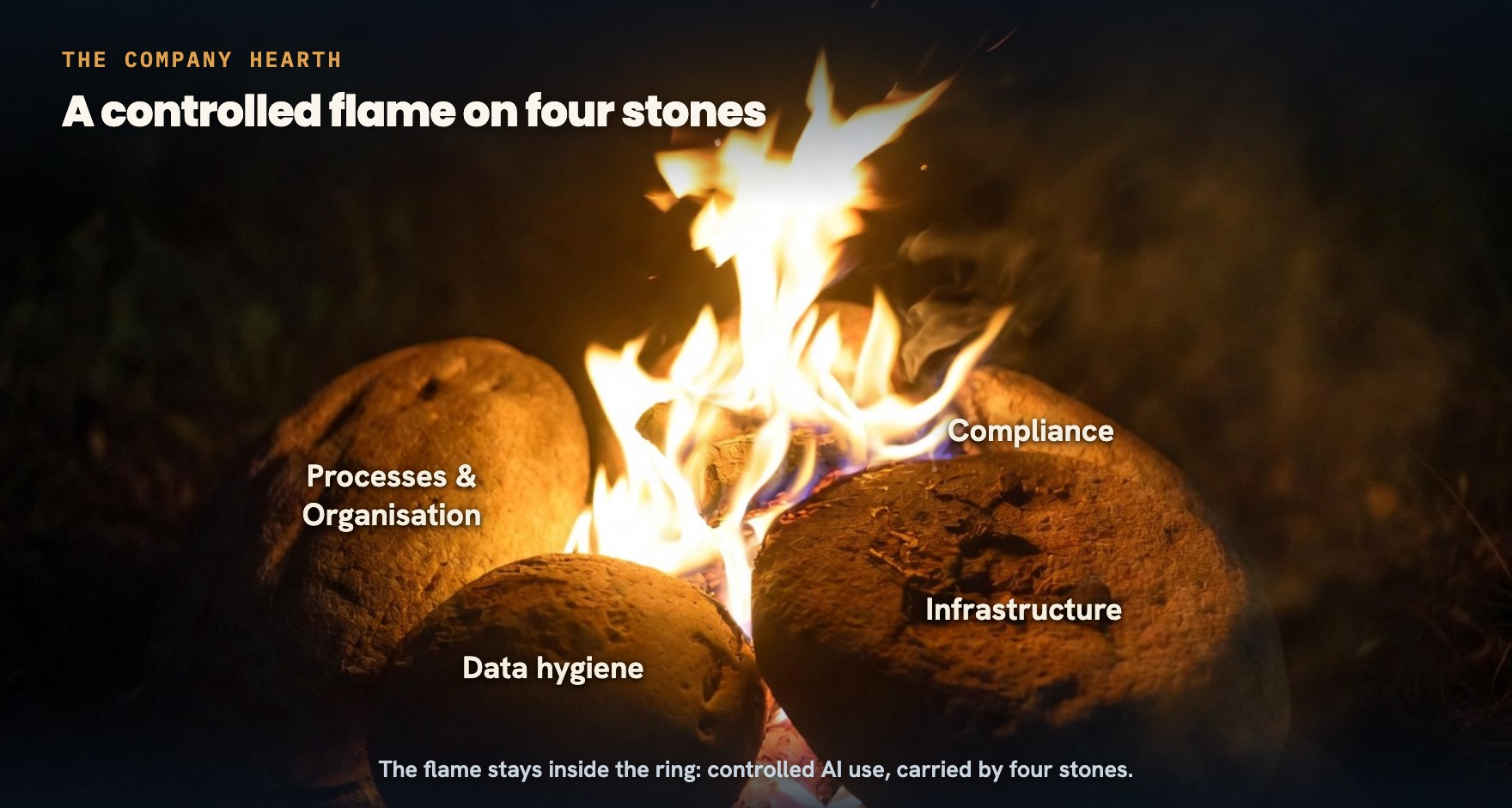
For a company this means bringing the flame indoors under control before it finds its own way in. And it will find its way in: through employees with private AI accounts, through software updates, through competitors. The company hearth rests on four stones, which we call the four pillars:
- processes and organisation
- data hygiene
- infrastructure
- compliance
On top of it burns a small flame first, one limited use case with measurable benefit, for instance an assistant working with RAG on your own company knowledge. And around the fire stand people who know how to handle it. Training means two things here: being able to operate the tool, and understanding where it creates value in your own company, and where it is better left alone.
Stoves and firewalls belong together
It built hearths, ovens and power plants, and alongside them firewalls and fire brigades. The two belong together. Whoever builds the hearth in their company today decides for themselves what burns. The others leave it to flying sparks.
The first step
Handling fire can be learned. Our workplace AI training starts exactly there: with the foundation of four pillars and with the small, controlled flame. Modules 1 and 2 are free for the first 50 seats, up to two per company. So that the first flame in your company burns where you decided it should.
The fire is coming either way. The hearth is your decision.
Author: Georges Leuenberger, in dialogue with Claude (Anthropic).