
«That is just how I do it» cannot be delegated. Not to an AI either.
Operational AI builds on working processes. When it meets a process nobody ever wrote down, and a file store holding three versions of the same data sheet, it multiplies the problem instead of solving it.
An unclear process costs more with AI than without
An AI does ask questions when something in the brief is unclear. But it can only ask about what lies in front of it. A new employee runs into the unwritten parts of a process in daily work: a colleague pauses, a customer complains, an invoice comes back. The AI has no such feedback channel. It works with what the brief contains and delivers a result that looks like a result, even when the same process is understood differently in three departments. That does not make the error more visible, it only produces it faster and in series.
The file store behaves the same way. If product descriptions sit on SharePoint in four versions, maintained by changing people, then every AI answer draws on one of them. Which one, nobody knows. This is why introducing AI starts with the foundation (processes, data, systems, ground rules) and not with the choice of tool.
Written down by the person who runs the process
«Describing processes» sounds like a management handbook. It starts more simply: what triggers the process, which steps follow, who decides, where does it regularly get stuck. Anyone who answers these questions for their own process quickly notices how much of it was never actually settled.
What matters is who answers them. That belongs to the person who runs the process every day. They know the point where it really jams, and they are the first to notice whether the AI-supported process holds up in practice. That makes them the most valuable tester a company can field.
Once the process is written down, a second question becomes possible
The first question is this: which steps cost time that an AI can take over? A draft quotation from the customer data, a summary of prior correspondence, a contract check against your own terms.
The second question goes further: which steps should be cut differently? Some loop across three people exists only because nobody had the time to read the documents in full. Remove that reason and the loop disappears. This question can only be asked once the process is on paper.
Processes that would not exist without AI
A machine builder with sixty employees receives several thousand field service reports every year. Free text, every technician writes differently. Until now they end up in the archive. The process «evaluate service reports» appears in no handbook, because it was unaffordable: reading thousands of reports costs weeks.
With AI it becomes a weekly run that collects fault patterns per assembly and puts three findings on the engineering desk. Nothing was accelerated here. The company gained a process it never had before. The precondition stays the same: the reports must be available digitally and the AI must be able to reach them.
Where our training programme starts
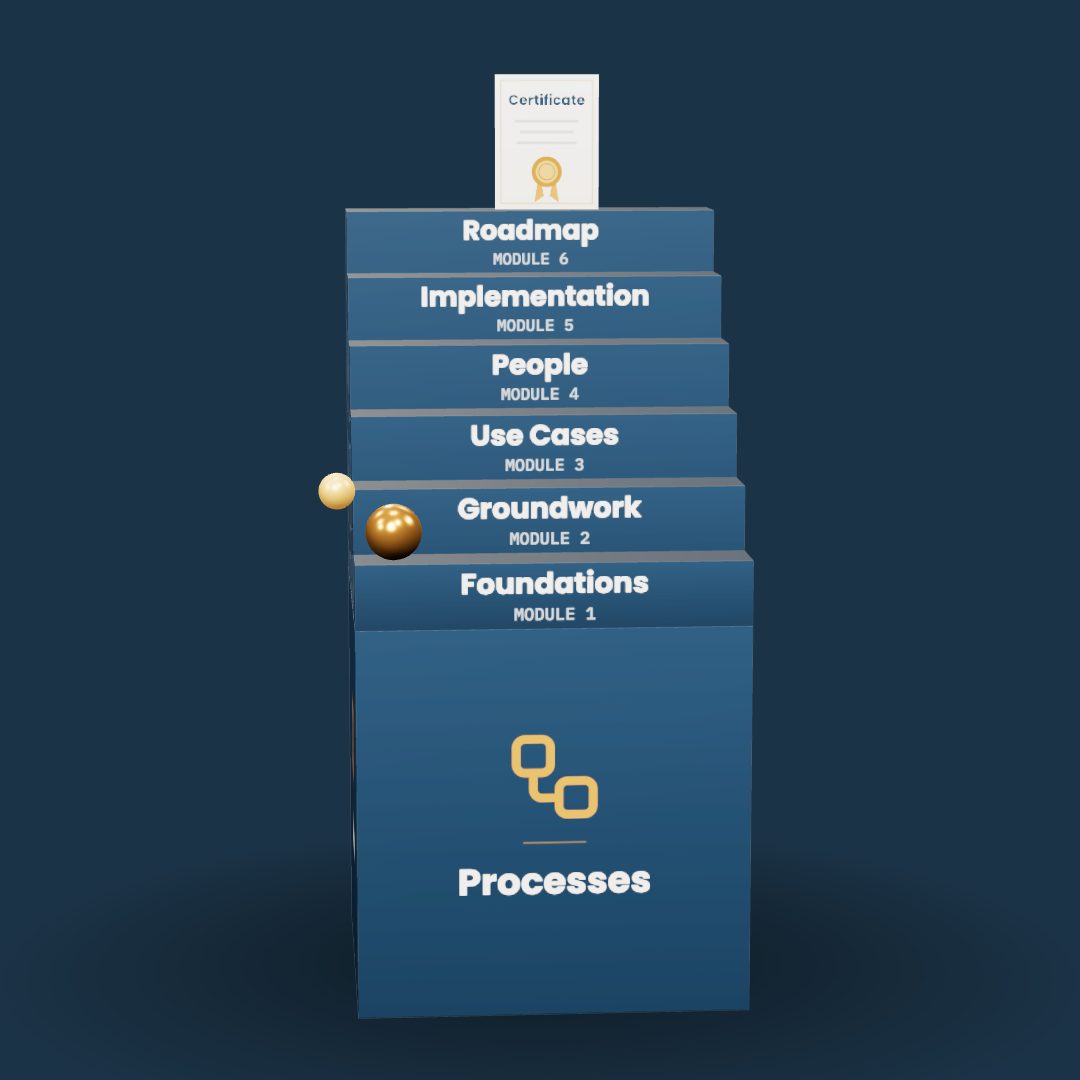
This is why our operational AI training is not aimed at prompting and context engineering alone. From module 2 onwards, every participant produces work pieces about their own company: a process profile, a data map, a system inventory. The AI tutor asks where things get stuck and shows, at that very point, what an AI could take over in that specific step.
What remains at the end is an assessment of your own company, written by the people who run it. Anyone completing six modules has worked with AI and has their own processes in writing for the first time.
Tools can be bought within the hour. Your processes will be described by nobody but your own people.